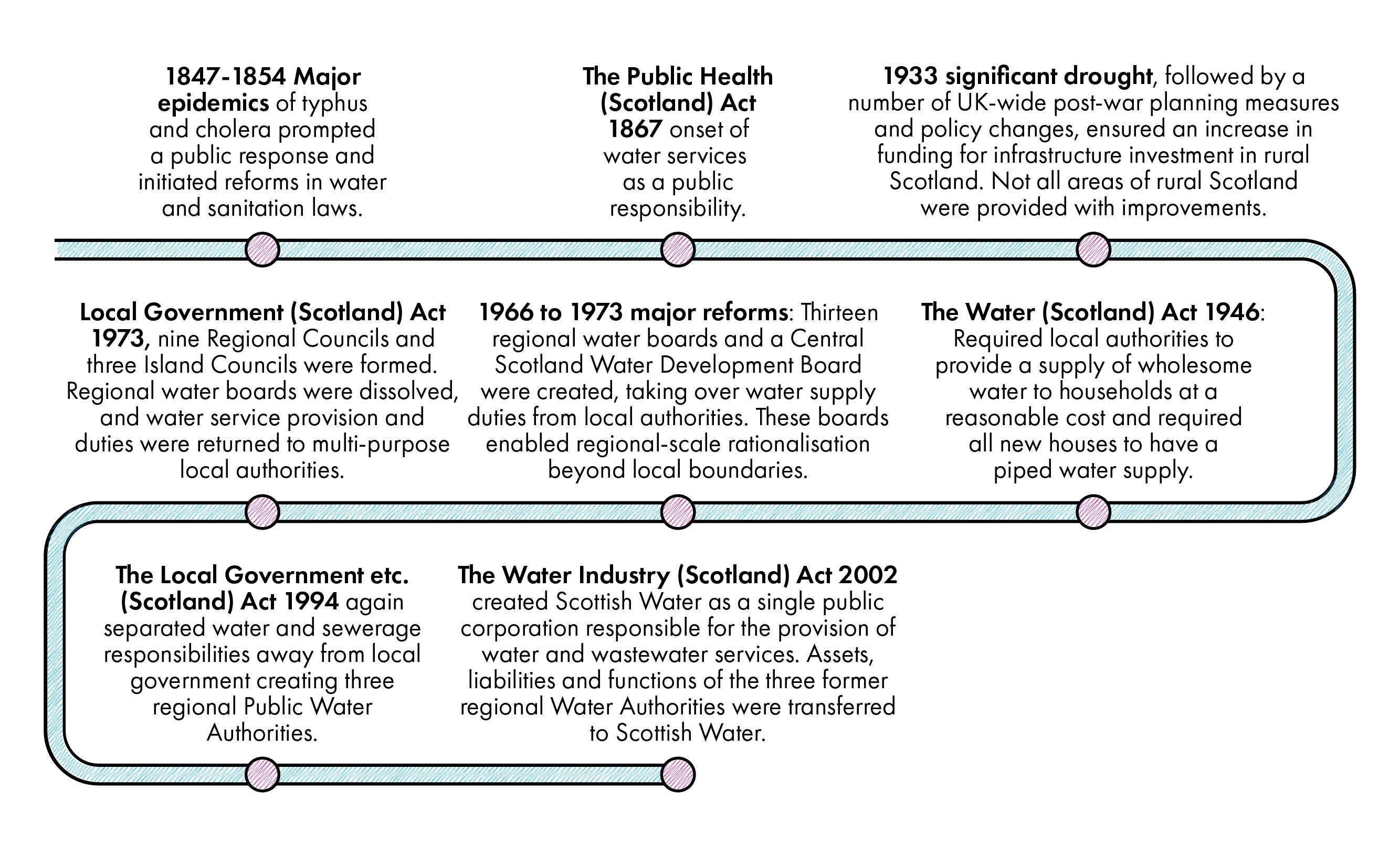
Sewell, W.R.D., Coppock, J.T., & Pitkethly, A. (1985). Insitutional innovtion in water management: the Scottish experience. Oxfordshire: Spon Press.
Lawson, E., Robbie, J., Sloan, W., & Amezaga, J. (1). Challenges and opportunities for decentralised water technologies in Scotland. Water Policy, 26(2). doi: 10.2166/wp.2024.194
Hendry, S. (2016). Scottish water - a public sector success story. Water International, 41(6), 900-915. doi: https://doi.org/10.1080/02508060.2016.1212961
Wilschnack, K., Cartmell, E., Yates, K., & Petrie, B. (2024). Septic tanks as a pathway for emerging contaminants to the aquatic environment–Need for alternative rural wastewater treatment?. Environmental Pollution, 362(124988). doi: https://doi.org/10.1016/j.envpol.2024.124988
Dobson, B., Coxon, G., Freer, J., Gavin, H., Mortazavi-Naeini, M., & W.Hall, J. (2020). The Spatial Dynamics of Droughts and Water Scarcity in England and Wales. Water Resources Research, 56(9). doi: https://doi.org/10.1029/2020WR027187
Peters, J., Roberts, J., McGuire, S., Willmott, E., Tunaley, C., White, C., … Major, L. (2025). Assessing Water Scarcity Reporting in Scotland: A report from SEPA–University of Strathclyde Innovation Partnership Secondment. University of Strathclyde. doi: https://doi.org/10.17868/strath.00093463
Peters, J., Roberts, J.J., McGuire, S., Willmott, E., Tunaley, C., White, C., … Major, L. (2025). Dataset of Daily Water Scarcity Level in Scotland (1991 - 2025). University of Strathclyde. doi: https://doi.org/10.15129/ea4d17fe-6d09-44da-b7d5-d3eae5249313
SEPA. (2025). Personal Commmunication.
SEPA. (2011). SEPA Position Statement to support the implementation of the Water Environment (Controlled Activities) (Scotland) Regulations 2011: WAT-PS-08-01: Untreated Sewage Discharges. Retrieved from
https://www.sepa.org.uk/media/152649/wat_ps_08_01.pdf [accessed 3 June 2025]
Li, X., Shen, X., Jiang, W., Xi, Y., & Li, S. (2024). Comprehensive review of emerging contaminants: Detection technologies, environmental impact, and management strategies. Ecotoxicology and Environmental Safety, 278, 116420. doi: https://doi.org/10.1016/j.ecoenv.2024.116420